It was a Tuesday morning, the kind that usually felt routine, until I walked into the kitchen and saw the crisp white envelope magnetically attached to the stainless steel of the refrigerator. It was addressed in my husband’s handwriting.
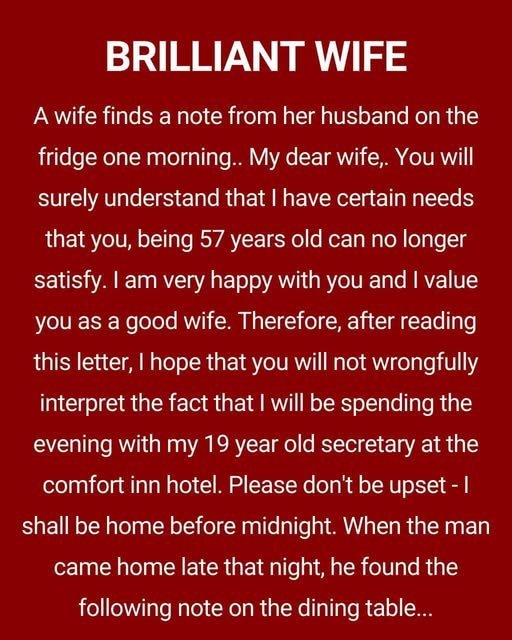
I opened it, expecting a grocery list or a reminder about the leaky faucet. Instead, I read words that felt like a cold splash of water. He had written with a clinical, detached politeness: “My dear wife, you will surely understand that I have certain needs that you, being 57 years old, can no longer satisfy. I am very happy with you and I value you as a good wife. Therefore, after reading this letter, I hope that you will not wrongfully interpret the fact that I will be spending the evening with my 19-year-old secretary at the Comfort Inn.”
He ended it with a casual, almost breezy, “Please don’t be upset—I shall be home before midnight.”
I didn’t scream. I didn’t throw the letter across the room. I simply stood there, the cool air of the kitchen washing over me, and felt a strange, chilling clarity. He thought he was playing a game of solitaire, oblivious to the fact that I had been keeping score for a long time.
I didn’t spend the day crying over a glass of wine. I spent it preparing. After all, I had taught algebra, calculus, and statistics for over thirty years—if there is one thing a math teacher understands, it is the importance of absolute equality in an equation.
When my husband sauntered through the front door well past midnight, smelling faintly of cheap cologne and arrogance, he expected a tearful, diminished woman. He expected a scene of heartbreak. Instead, he found the house dark, save for the dining table, where a single note sat waiting under the warm glow of the overhead light.
He picked it up, his smile faltering as his eyes scanned the page.
“My dear husband,” I had written. “I received your letter and thank you for your honesty about me being 57 years old. I would like to take this opportunity to remind you that you are also 57 years old.”
I could almost see his expression darken as he read the next paragraph. I had detailed my evening with a surgical, mathematical precision that I knew would cut deeper than any insult:
“I would like to inform you that while you read this, I am at the Hotel Fiesta with Michael, one of my students, who is also the assistant tennis coach. He is young, virile, and, like your secretary, he is 19 years old.”
Then came the part I had spent all afternoon perfecting—the math teacher’s coup de grâce:
“As a successful businessman who has an excellent knowledge of math, you will surely understand that we are in the same situation. However, there is one small difference: 19 goes into 57 more times than 57 goes into 19. Therefore, I will not be home until sometime tomorrow.”
I can only imagine him standing there in the silence of the foyer, the paper trembling slightly in his hands, realizing that his attempt to make me feel small had only served to demonstrate his own lack of foresight. He had treated our marriage like an asset to be liquidated, never stopping to calculate the cost of the exit strategy.
He wanted a night of excitement? He got a lesson in probability. He wanted a trophy? He got a reality check. And as I lay in a hotel bed across town, listening to the quiet hum of the city, I realized that for the first time in thirty years, the math finally balanced perfectly.