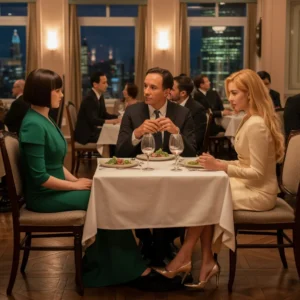

My mother, working two jobs at a diner to pay off medical bills after her surgery. The humiliation, years of it, bowing and scraping before the Harringtons, begging for scraps of their approval.
“Why?” The word tears out of my throat, sharp and raw. “If he had this—if he had all of this—why did he let us live like that?
Why did he let them… why did he let them speak about him that way?
At his own funeral. He let us suffer.”
Galen’s expression softens, the deep sadness returning. “He was terrified, Harper.
Terrified of what this—” he gestures to the room, the house, the empire “—does to people.
He watched it destroy other families, poison other children. He saw partners raise sons and daughters who were empty inside, arrogant and cruel.”
He is describing the Harringtons.
“He was adamant,” Galen continues. “You would grow up outside the walls.
You would know the value of work.
You would know humility. You would be normal. You would be his daughter, not the trust’s.
He wanted you to be old enough and strong enough to make this choice yourself, not to be born into it as a prisoner.”
He was right.
He was right—and he was unbelievably cruel. He had protected me from the poison of wealth by letting me be steeped in the acid of humiliation.
“I cannot make this decision for you,” Galen says, moving toward the door. “This is a shock.
You need time.
Take seventy‑two hours. Go home. Think about the life you thought you had, and think about the one your father built for you.”
The woman, who has been silent as a statue, still watches me.
Her face is impossible to read, but her eyes hold a spark of certainty, as if she already knows the answer.
My gaze falls on a small table near the door. On it sits a single, thick envelope of cream‑colored vellum.
It is sealed with a simple disc of dark red wax. My father’s familiar, strong handwriting is on the front.
It says only one word.
HARPER. “Caleb left that for you,” Galen says, noticing my stare. “It is to be opened only if you accept the seat on the trust.
Not before.”
He nods to the woman.
“She will see you home. The motorcade will wait.”
The armored sedan drops me off two blocks from my apartment.
The driver, following orders, has offered to wait, to drive me to a secure hotel, to take me anywhere. I just want to go home—though the word feels hollow.
I walk the last two blocks in the dark.
The transition from the silent leather‑and‑wood tomb of the car back to the real world is jarring. The air in my neighborhood smells like damp pavement and fast food. Our apartment is on the third floor of a walk‑up.
I can hear the muted sound of a neighbor’s television through the thin walls as I climb the stairs.
When I open the door, the smell of our life—stale coffee, my mother’s cheap floral perfume, and the lingering scent of old grief—hits me like a physical blow. My mother is sitting in the dark in my father’s threadbare armchair.
She looks up as I enter, her face a pale, puffy mask in the gloom. “Harper, where did they take you?”
I can’t look at her.
Not yet.
The knowledge that she knew something is a chasm between us. “I need to be alone,” I say, my voice flat. I walk past her into my father’s “study,” which is just a desk crammed into a corner of the living room.
It is piled high with cardboard boxes, his life packed away.
I hadn’t been able to go through them before. Now I have to.
I open the first box. It is full of his clothes—old, worn‑out polo shirts, the collars frayed.
A plaid flannel shirt I’d given him for Christmas five years ago, the elbows worn thin.
It all smells like him, a faint scent of soap and old paper. In another box: his things. His chipped coffee mug, the one I bought him from a drugstore that said WORLD’S BEST DAD.
He’d used it every single morning.
His watch—a cheap gold‑plated timepiece with a cracked crystal, the kind you buy from a revolving glass case at the mall for thirty dollars. He had worn it every single day of his life that I can remember.
It was a costume. All of it.
The cheap car, the threadbare shirts, the chipped mug, the broken watch.
It was a lie—a performance of poverty he had maintained for twenty‑six years. I sink onto the floor, the watch cold in my palm. The anger and betrayal I’d felt in the car return so strong they make me sick.
Then my fingers brush against the envelope in my coat pocket.
It feels alien here, its thick cream‑colored vellum a stark contrast to the flimsy cardboard boxes. It is heavy, sealed with that ominous red wax.
To be opened only if you accept the seat. Galen’s rule.
But Galen isn’t here.
And this man—this stranger who built an empire while pretending to be a pauper—owes me an explanation. I need to know who he was before I can decide whether to accept his world. I break the wax seal with my thumbnail.
My hands tremble as I unfold the heavy pages.
It is his handwriting, the strong, architectural script I know from a thousand birthday cards and notes left on the fridge. My dearest Harper,
If you are reading this, then I am gone.
Galen Armitage has kept his word. You are now standing at the edge of a world I spent your entire life trying to protect you from.
You are angry, and you have every right to be.
You feel betrayed. Let me, if I can, tell you why. I did not build Horizon for the money, Harper.
I built it with Galen as a shield.
We saw a world where good people were crushed by predators, and we wanted to build a fortress to stop them. But I watched the fortress grow.
I saw what the power and the money did to the people inside it. I saw it happen to other families.
I saw their children, raised with everything, turn into people with no empathy, no strength, no core.
They were hollow, ostentatious, empty shells. I saw your mother’s family, Harper. I saw the Harringtons.
My greatest fear, the one that kept me awake more nights than any corporate threat, was that this world would find you—that it would take my daughter, my bright, kind, fierce girl, and turn you into a version of them.
I was terrified you would become someone who sneered at a person’s shoes or judged a man’s worth by his bank account. So I hid.
I hid you. I hid your mother.
And I hid myself.
I tried to build your armor differently, not with money, but with principle. My vision blurs. I remember, suddenly, a dozen small, forgotten moments.
My father at a diner, leaving a twenty percent tip on a small bill, even when the service was terrible.
“She’s working, Harper,” he’d said, his voice firm. “We don’t punish people for working hard.”
I remember hearing Aunt Victoria once snipe about a neighbor being “poor but proud.” My father had gone quiet.
Then later he told me,
“Don’t ever let anyone tell you pride is a luxury. Self‑respect is the only currency that matters.
It is worth more than any bank account on earth.”
He wasn’t teaching me to be poor.
He was teaching me how to survive being rich. I read the last page. My father’s script is heavier here, the ink pressed deep into the paper.
There is one last thing you must know, and it is a hard truth.
It will change how you see your mother. You must know it before you choose your path.
Years ago, when you were small, I offered her a different life. Horizon was stable.
I offered to move us.
I had plans drawn up for a house near the Armitage estate. I begged her to let me stop this performance. I was tired, Harper.
I just wanted to be her husband, not her family’s charity case.
It was your mother who refused. She was terrified—not of the money, but of her family.
Of Victoria. Of what they would say.
That she had married up, that she was putting on airs, that she was abandoning them.