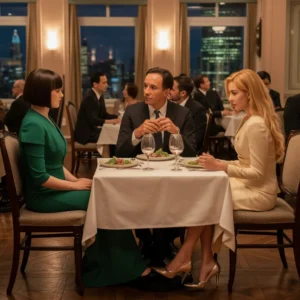
She leaned forward, her eyes narrowing with malicious delight. “Let’s be honest, Collins. We’re family.
We can say these things. It’s been eighteen years. Eighteen years in the Army.” She pointed with her fork at Nathan’s chest where a rack of colorful ribbons sat proudly on his blue uniform.
“Look at Nathan. He’s a Christmas tree of valor. And you?” She gestured to my plain gray blazer.
“Not a single ribbon, not a single medal to hang on the wall. Nothing.”
I placed my knife and fork down. I aligned them perfectly parallel on the plate.
It was a grounding technique—order in chaos. “Awards in my line of work aren’t usually public, Aunt Marjorie,” I said softly. “Excuses,” she scoffed.
“If you do something brave, they pin a medal on you. That’s how it works. If you don’t have medals, it’s because you haven’t done anything.
Is that it? Is your job just making coffee for the generals? Is that why you never talk about it?”
She laughed again, looking around the table for validation.
“Don’t be ashamed, Collins. Truly, the world needs people to file paperwork. Not everyone has the stomach for danger.
Some people just need a safe little hole to hide in while the real men do the work.”
The air in the room seemed to vanish. I looked at my mother, begging silently for her to say something. Say I’m smart.
Say I’m hardworking. Say anything. But she just took a sip of water, her hand trembling.
I was alone. I looked away from my mother and fixed my gaze on the centerpiece of the table. A single tall white candle burned in the middle of the autumn arrangement.
The flame flickered, dancing in the draft from the window. It was mesmerizing. It was hypnotic.
And suddenly, I wasn’t in a dining room in Arlington anymore. The smell of roast turkey vanished, replaced by the scent of damp earth and freshly cut grass. The white tablecloth faded into the pristine white marble of a headstone.
The flickering candle wasn’t a decoration. It was the eternal flame of memory. The insult about hiding from danger echoed in my ears, but it swirled together with a voice from the past, dragging me backward, down into the deep, dark well of memory where the real scars began.
The flame of the candle blurred, pulling me back to a gray, drizzly morning in Arlington National Cemetery twenty-eight years ago. I was twelve. The world felt too big, too cold, and entirely too empty without my father.
The grass was impossibly green, contrasting sharply with the rows of white marble headstones that stretched out like silent soldiers standing at eternal attention. My father’s funeral wasn’t a grand affair. He was a quiet man in life, and he remained a quiet man in death.
There were no news cameras, no crowds of weeping admirers, just a small group of men in trench coats who stood at a respectful distance, their faces hard and unreadable, and the honor guard performing the flag presentation. I watched, mesmerized and heartbroken, as the soldiers folded the American flag. Thirteen folds, precise, sharp, meaningful.
Each fold a tribute to a life given in service. When the officer knelt in front of my mother and presented the tight blue triangle with the white stars facing up, he whispered the words I would memorize forever. “On behalf of the President of the United States, the United States Army, and a grateful nation…”
My mother took the flag, her hands trembling so violently she nearly dropped it.
I wanted to reach out, to touch the coarse fabric, to feel the last physical piece of my father. But then Marjorie’s voice cut through the solemn silence like a serrated knife. She was standing right behind us, dressed in a black coat that looked more appropriate for a fashion runway than a burial.
She leaned toward my mother, not to offer a tissue or a hug, but to whisper something that would burn a hole in my heart. “See, Sarah,” Marjorie hissed, her breath smelling of mints and judgment. “This is the price of stubbornness.
If he had just listened to me and gone into commercial real estate, he’d still be here. He’d be closing deals in D.C., not rotting in a wooden box for a pension that won’t even cover your rent.”
I froze. The tears drying on my cheeks turned cold.
At twelve years old, I didn’t have the words to fight back, but I felt the acid of her words eating through me. To Marjorie, my father wasn’t a patriot who died protecting assets in Eastern Europe. He was a bad investment.
He was a failure because he didn’t leave behind a portfolio of strip malls and duplexes. That moment defined the rest of my life. It drew a line in the sand.
On one side was Marjorie’s world, loud, shiny, and hollow. On the other was my father’s world, silent, dangerous, and honorable. I chose my side right then and there.
As I grew up, the divide only deepened. While Nathan was being groomed to be the golden child, I became the ghost. I remember my tenth birthday.
It was a Tuesday. I had woken up with that specific bubbly excitement that only a child feels, waiting for the balloons, the cake, the happy birthday song. I waited all morning.
Then all afternoon. By dinnertime, the silence was deafening. Mom was rushing around the kitchen, but not for me.
Marjorie and Nathan had come over. “Did you hear?” Marjorie announced, bursting through the door, her voice booming. “Nathan won the regional swim meet.
First place in the freestyle. My little Olympian!”
Nathan, dripping wet hair and holding a cheap plastic trophy, beamed. Mom clapped, her face lighting up in a way it never did for me.
“Oh, that’s wonderful. We have to celebrate. Let’s order pizza.”
I sat on the stairs hugging my knees.
My tenth birthday, double digits, and it had been completely erased by a swimming trophy. I didn’t say a word. I just went back to my room, pulled out my math homework, and worked until my eyes blurred.
If they weren’t going to love me, I decided I would make sure they couldn’t ignore me. I would be undeniable. By high school, I was undeniable—but not in the way Marjorie valued.
When I was accepted into West Point, the United States Military Academy, it was one of the proudest moments of my life. I had worked myself to the bone. I was the valedictorian of my class.
I placed the acceptance letter on the kitchen counter, waiting for someone to notice. Marjorie saw it first. She picked it up with two fingers as if it were a dirty napkin.
“West Point?” she sniffed, tossing it back down. “Good Lord, Collins. Why would a girl want to go there?
Short hair, marching in the mud, no social life. It’s so dry.”
She turned away, dismissing four years of my hard work in four seconds. “Look at Nathan,” she said, pointing out the window to where my cousin was throwing a football in the yard.
“He’s captain of the varsity team. He’s going to UVA. He’ll be pledging a fraternity, making connections, living the life.
That is a future. That is success.”
She was right about one thing. Nathan was loud.
He was the star of Friday night lights. The whole town knew his name. No one knew mine.
I was the girl in the library. I was the girl running track alone at 5 a.m. before school.
I chose intelligence for the same reason I chose West Point. I wanted to be like the men in the trench coats at my father’s funeral. I wanted to be effective, not famous.
I wanted to protect the country from the shadows. But in this family, if you weren’t on a billboard, you didn’t exist. If your achievements couldn’t be toasted with champagne at a country club gala, they weren’t real.
For twenty years, I had swallowed that pill. I let them think I was a glorified secretary. I let them think I filed papers and fetched coffee.
It was safer that way. The nature of my job demanded silence. My security clearance demanded anonymity.
But God, it hurt. It hurt to sit there year after year and be treated like the family charity case while I was authorizing operations that kept them safe enough to sleep at night. If you’ve ever felt like the black sheep because you chose a path your family didn’t understand, hit that like button right now and tell me in the comments.